
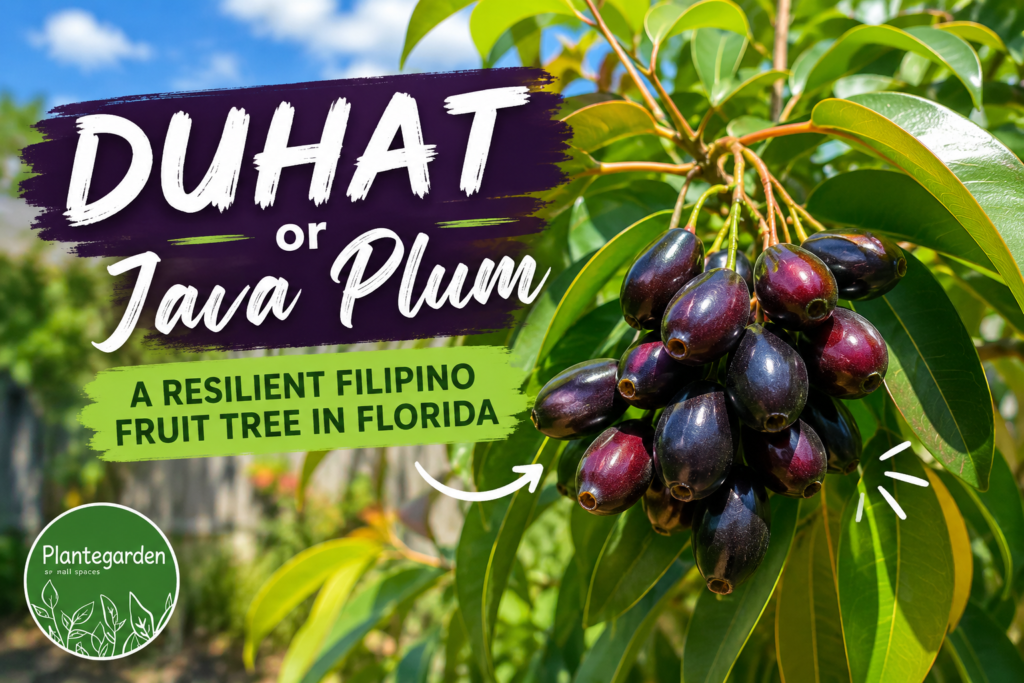
If you grew up in the Philippines, you may know this fruit tree as Duhat. Elsewhere, it is commonly called Java plum or Jambolan. Its scientific name is Syzygium cumini.
For me, Duhat is more than another tropical fruit tree. I have two growing in my Florida garden—one larger and one much smaller—and both have surprised me with how well they recover after cold weather.
They also produce plenty of new leaves, which is one reason I find myself trimming them regularly.
What Is Duhat?
Duhat is an evergreen fruit tree in the myrtle family. It can become a large tree under favorable conditions, with glossy, leathery leaves and small fruits that mature from green to reddish-purple and eventually dark purple or nearly black.
The ripe fruit is usually eaten fresh, although Duhat can also be used in various food preparations.
The Philippine Department of Science and Technology’s Food and Nutrition Research Institute lists Black/Java plum under the scientific name Syzygium cumini, with Duhat and Jambolan among its common names.
Why I Like Growing Duhat
One of the biggest reasons I like this tree is its resilience.
I have two Duhat trees in my garden. One is considerably larger than the other, but both have survived cold weather and recovered afterward.
Even the smaller tree came back with new growth.
Once the weather warms up, these trees can produce a surprising amount of foliage. I regularly trim mine because they can become quite leafy.
I would not call Duhat frost-proof or claim that every tree will survive every freeze. Cold damage can still occur. But based on my own experience, the ability of these trees to recover is one of their most impressive characteristics.
That experience also reminds me of something I learned with my mango tree. If you are interested in how plants can respond after a Florida freeze, I also wrote about How My Mango Tree Survived a Florida Freeze and Grew Back Stronger.
Growing Duhat in Florida
Duhat is a fast-growing tree under suitable conditions, and UF/IFAS describes it as a long-lived evergreen that can become quite large. Its glossy leaves and dense growth make it very different from many smaller backyard fruit plants.
If you are thinking about growing one, give the tree room to develop. A small plant can eventually become a substantial tree.
Good growing conditions generally include:
- Plenty of sunlight
- Well-drained soil
- Regular water while establishing
- Enough space for the mature tree
- Occasional pruning when growth becomes excessive
Because Duhat can become large, planting location matters. This is not a fruit tree I would squeeze into a small planting bed without considering its eventual size.
What About the Health Benefits of Duhat?
This is one of the most interesting parts of Duhat, but it is also where online articles often go too far.
The fruit does have measurable nutritional value. According to the Philippine DOST Food Composition Table, 100 grams of edible Duhat contains about 71 calories, 16 grams of carbohydrate, 23 mg of calcium, 19 mg of phosphorus, 0.4 mg of iron and 18 mg of vitamin C.
Duhat also contains various plant compounds, including phenolics, flavonoids and other bioactive compounds that researchers continue to investigate.
What researchers are studying
Research involving Syzygium cumini has investigated possible antioxidant, blood-glucose, lipid-related, anti-inflammatory and other biological effects.
A Philippine study using freeze-dried Duhat fruit found antioxidant activity and changes in triglycerides and HDL cholesterol in laboratory mice. That is interesting research, but it was an animal study, not proof that eating Duhat produces the same results in people.
Blood-sugar research is another major area of interest. A 2026 systematic review and meta-analysis of randomized trials involving Syzygium and related Myrtaceae plants found a modest reduction in fasting blood glucose, but the researchers noted substantial differences among studies and rated the certainty of evidence low to very low for important outcomes.
So I would put it this way:
Duhat is a nutritious fruit with interesting bioactive compounds, and researchers are studying its potential health effects. It should not be presented as a proven treatment for diabetes or other diseases.
The leaves, seeds and bark have also been studied for various biological properties, but the evidence varies by plant part and study. Laboratory findings should not automatically be treated as proven human health benefits.
An Important Florida Consideration
There is one issue that Florida gardeners should know before planting Duhat.
UF/IFAS currently classifies Syzygium cumini as invasive in South Florida. Its assessment, however, lists the species as not a problem species in Central Florida and not a problem species in North Florida based on the current assessments.
That distinction matters.
UF/IFAS also notes that Java plum can spread through its fruit, which is readily eaten by wildlife.
So before planting one, check the guidance that applies to your part of Florida rather than assuming that what works in one region is appropriate everywhere.
My Take on Duhat
After growing two of these trees, I understand why Duhat has remained such a familiar fruit tree for many Filipinos.
It is productive, vigorous and, in my experience, remarkably resilient.
My two trees have survived cold weather, recovered, and continued producing new leaves. The smaller one has done it too, which impressed me even more.
For me, that is the story behind Duhat.
It is not just a Filipino fruit I remember. It is a tree I can actually grow in my Florida garden.
And sometimes the best gardening lessons come from watching what survives in your own yard.
A Note About Health Claims
The nutritional information and research discussed here are provided for educational purposes. Research on Duhat includes laboratory, animal and human studies, but the evidence is not strong enough to present Duhat, its leaves, seeds or bark as a treatment or cure for a disease.