
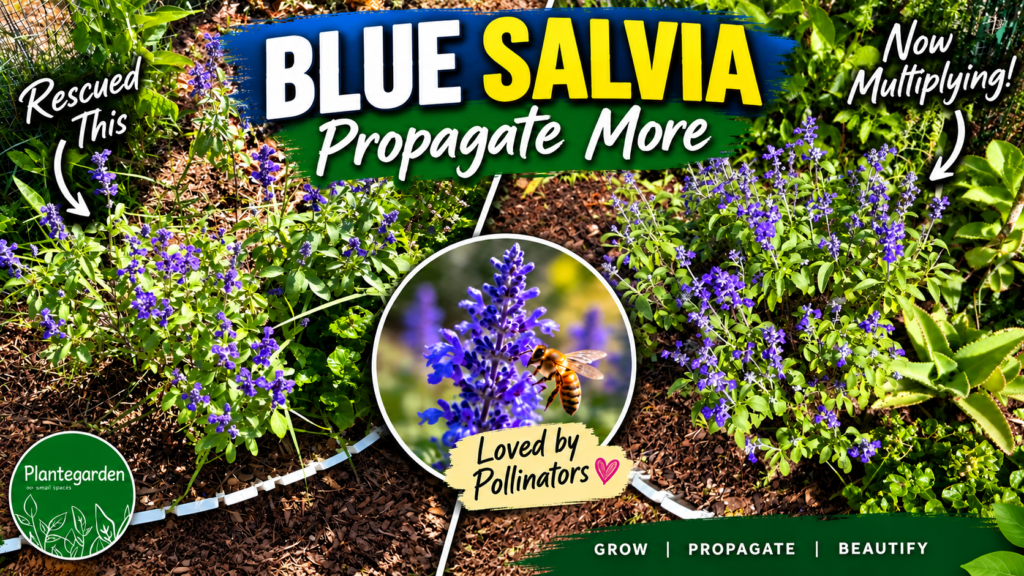
I didn’t buy my Blue Salvia.
I rescued it.
The plants were about to be thrown away or composted, so I brought them home and gave them a place in the garden. I didn’t know much about them at first.
What happened next got my attention.
They started growing and blooming with surprisingly little care.
And when those blue flowers opened, I noticed something else: bees really liked them. I’ve seen two or three bees working around the flowers at the same time.
Now I want more of these plants around the garden.
Instead of buying more, I’m going to propagate the plants I already have.
What Is Blue Salvia?
The plant commonly called Blue Salvia is Salvia farinacea, also known as mealycup sage.
It belongs to the Lamiaceae family, better known as the mint family. That’s the same large plant family that includes mint, basil, rosemary, oregano, lavender, and common culinary sage.
You can often recognize members of this family by features such as square stems and opposite leaves. Blue Salvia has those characteristics too.
But there’s an important point here:
Being in the mint family doesn’t mean every member is a culinary herb.
Is Blue Salvia Edible?
This is one thing I want to make clear because the word “sage” can be confusing.
Blue Salvia is related to common sage, but I would not treat Blue Salvia like a kitchen herb or use it as a substitute for mint or culinary sage.
If you want something to cook with, grow a plant specifically identified as an edible culinary herb.
For Blue Salvia, I’m growing it for what it does best in my garden:
flowers, color, and pollinators.
Why I Like This Plant
So far, my Blue Salvia has been pretty easygoing.
It has been growing and blooming without demanding much attention from me.
That doesn’t mean every garden will produce exactly the same results. Sunlight, soil, water, temperature, and local conditions all matter.
But my experience has been simple:
I rescued the plants, planted them, and they took off.
UF/IFAS describes Blue Salvia as a fast-growing plant that can handle full sun to partial shade and several soil types.
That’s a pretty good combination for a Florida garden.
Blue Salvia Is Great for Pollinators
The flowers aren’t only there for us to enjoy.
UF/IFAS lists Blue Salvia as a plant that attracts bees and hummingbirds.
I’ve seen that firsthand.
When mine are blooming, I don’t just see one bee occasionally stopping by. I’ve seen two or three bees around the blue flowers at the same time.
Blue-purple flowers are also among the colors that UF/IFAS identifies as attractive to native wild bees.
So if you’re trying to add more flowering plants to your garden for pollinators, Blue Salvia is worth considering.
And that’s another reason I want to multiply mine.
More plants means more flowers.
How Do You Propagate Blue Salvia?
Propagation simply means making new plants from an existing plant.
There are several ways to do it, including:
- Stem cuttings
- Seeds
- Division
For my project, I’m most interested in stem cuttings because I want to turn the plants I already have into several more.
UF/IFAS specifically says Blue Salvia can be grown from seed or cuttings and reports that 3- to 4-inch softwood cuttings from young shoots root readily.
That’s encouraging.
How I’m Going to Propagate Mine From Cuttings
The basic process is simple.
1. Choose a healthy shoot
Look for a young, healthy stem that isn’t covered with flowers.
A 3- to 4-inch cutting is a good starting point for Blue Salvia.
2. Make the cut
Use clean, sharp pruning shears.
Make the cut just below a leaf joint, or node.
3. Remove the lower leaves
Take off the leaves from the lower part of the cutting.
The goal is to leave enough stem to place into the rooting medium without burying a bunch of leaves.
4. Plant the cutting
Place the lower portion into a clean, well-draining propagation medium.
Keep the medium moist, but don’t turn it into mud.
UF/IFAS recommends keeping stem cuttings warm and humid while they develop roots and notes that a clean rooting medium helps reduce problems.
5. Give it the right conditions
Keep the cutting in bright light while protecting it from harsh conditions that could dry it out.
The cutting needs moisture while it is developing roots, but excessive water can create its own problems.
6. Be patient
Don’t pull the cutting out every few days to check for roots.
Give it time.
Once roots have developed and the new plant is growing, gradually get it accustomed to normal outdoor conditions before planting it permanently. UF/IFAS calls this process hardening.
Can You Grow Blue Salvia From Seed?
Yes.
UF/IFAS reports that Blue Salvia can be grown from seed, and its plant information gives a germination time of roughly 12 to 15 days at 70°F.
Seeds are another way to multiply your plants.
But for what I’m trying to do, cuttings are more interesting.
I already have plants I like.
Why not make more of those?
What About Dividing the Plant?
Division is another propagation method used with salvias.
However, I’m going to start with cuttings rather than digging up and dividing my existing plants.
If the cuttings work, I can increase the number of plants without disturbing the established ones.
One Plant Can Become Many
This is the part that makes propagation so interesting to me.
You don’t necessarily need to keep buying new plants.
If you have a healthy plant that propagates successfully, you can use it to create additional plants.
UF/IFAS explains that asexual propagation allows gardeners to increase the number of plants they have and can reproduce plants with the same characteristics as the parent plant.
That’s exactly what I’m hoping to do with these rescued Blue Salvias.
A few plants that were almost compost could eventually become a whole section of the garden.
A Good Plant for a Beginner?
Based on my experience so far, I’d say Blue Salvia deserves a look if you’re searching for a flowering plant that doesn’t seem overly demanding.
It’s colorful.
It attracts pollinators.
It can grow in Florida conditions.
And you can propagate it.
Those are several good reasons to give it a place in the garden.
If you’re working with limited space, you can also combine flowering plants with the other small-space ideas in our Plantegarden gardening resources.
For planning a larger garden, our Plantegarden Garden Planner can help you think about spacing and layout before planting.
Blue Salvia vs. Culinary Sage
Here’s the simple version:
Blue Salvia (Salvia farinacea)
Grown mainly for flowers, landscape use, and pollinators.
Common sage (Salvia officinalis)
A different Salvia species commonly grown as a culinary herb.
They share the Salvia genus, but that doesn’t mean they have the same purpose.
That’s an important lesson for beginning gardeners:
Knowing the plant’s family or genus isn’t enough to assume it’s edible. Identify the exact plant first.
What I Want to Do Next
My goal is pretty simple.
I want to take the Blue Salvia plants I rescued and see how many new plants I can successfully produce from them.
I’ll be watching for:
- Which cuttings develop roots
- How long rooting takes
- How quickly the new plants grow
- When they’re ready to move into the garden
- How well they perform after transplanting
So this isn’t just a propagation guide.
It’s an experiment happening in my own garden.
A plant that was almost thrown away is now blooming, attracting bees, and giving me the opportunity to make more plants.
I’ll take that.
More From Plantegarden
If you enjoy growing flowering plants and supporting pollinators, you can also explore our Red Hibiscus growing guide and our Garden News for more plant and gardening ideas.
For gardening supplies, our Recommended Garden Tools and Essentials includes pruning shears, gardening gloves, soil products, and other basic supplies that can be useful when propagating and maintaining plants.
One last thought: before you throw a healthy plant into the compost, take another look at it.
You might be throwing away your next garden full of flowers.