
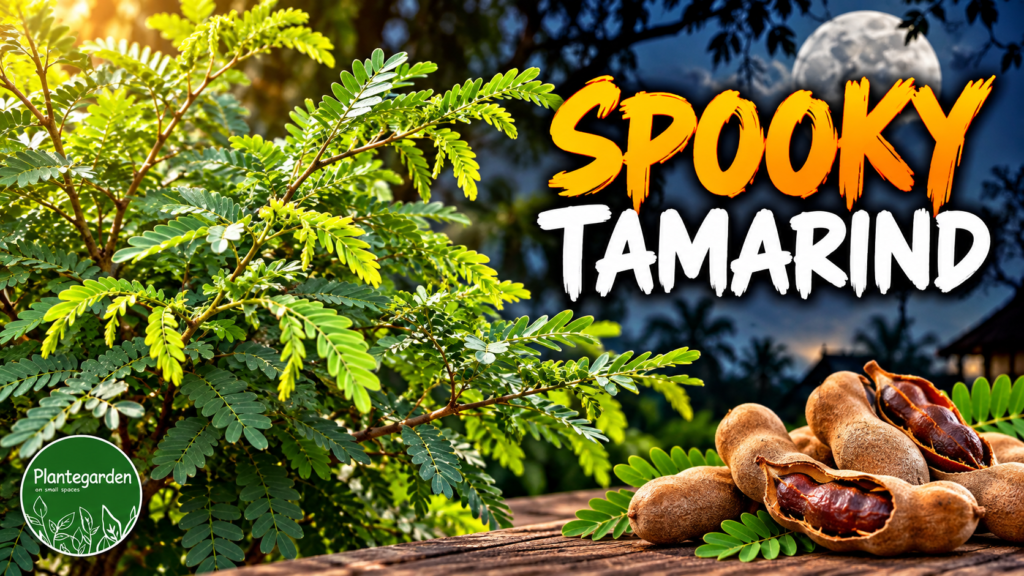
When I was growing up in the Philippines, there was a huge tamarind tree where two streets crossed in our neighborhood.
During the day, nobody thought much about it. It was simply a big old tree.
At night, however, the story changed.
People in the neighborhood believed that an engkanto might be associated with the tree, and children were especially cautious when passing it after dark. I remember that feeling myself. You didn’t necessarily have to see anything. Sometimes the story was enough to make you walk a little faster.
That childhood memory is one reason I think the tamarind tree makes a surprisingly good Halloween plant to talk about.
But there is much more to this tree than its spooky reputation.
What Is a Tamarind Tree?
Tamarind, known as sampalok in the Philippines, is Tamarindus indica, a long-lived tropical tree belonging to the legume family.
It can become a large tree with dense foliage and a broad canopy. In the Philippines, tamarind has become deeply established in everyday life and culture, even though the species originated outside the country.
The fruit is probably what most people know best. Its brown pods contain a sticky pulp with that unmistakable sweet-and-sour flavor.
Why Was the Tamarind Tree Considered Spooky?
This is where Philippine folklore gets interesting.
Engkanto is a broad term used in Philippine folklore for supernatural or enchanted beings associated with the natural world. Traditional stories have connected supernatural beings with particular trees and places.
There are also documented Philippine stories specifically involving tamarind trees. A study of local folklore in Nueva Ecija, for example, documented a folktale called “Sto. Niño 1st’s Tamarind Tree.”
Historical and literary sources also contain Philippine stories in which supernatural beings are associated with large trees, including tamarind.
So when I remember people being cautious around that enormous neighborhood tamarind tree, the idea wasn’t completely out of place in the wider tradition of Philippine folklore.
Of course, folklore is folklore. There is no scientific evidence that supernatural beings live in tamarind trees.
But that doesn’t make the stories any less interesting.
And Then We Ate the Fruit
Here’s the funny part.
The same tree that could make people nervous after sunset was also a valuable food plant.
In Filipino cooking, sampalok is one of the best-known souring ingredients for sinigang. Tamarind pulp is also used in drinks, candies, sauces, and other dishes.
And it isn’t only the ripe fruit that has culinary uses.
Young tamarind leaves are used in Filipino dishes, including sinampalukan, where the leaves provide a distinctive sour flavor.
The tree produces flowers and other useful plant parts as well, making tamarind much more than an ornamental tree.
Does Tamarind Have Nutritional Value?
Yes.
Tamarind pulp provides carbohydrates and dietary fiber along with minerals such as potassium and magnesium and several B vitamins. Philippine food and nutrition sources document its nutritional composition.
But there is one claim I’d be careful with: tamarind should not be presented as a proven weight-loss food.
There is interest in tamarind’s plant compounds and possible health effects, but that is different from proving that eating tamarind causes people to lose weight.
So enjoy the fruit for what it is—a flavorful food with nutritional value—rather than treating it as a weight-loss remedy.
Can You Grow a Tamarind Tree?
You can, if your climate is suitable.
Tamarind prefers warm, frost-free conditions, full sun, and well-drained soil. UF/IFAS notes that it is suited to frost-free regions and can be propagated from seed or cuttings, while grafting and other methods can be used when fruit quality is important.
This is a tree that needs room.
A mature tamarind can become quite large, so planting location matters. Dropping pods can also create a mess on hard surfaces.
For a small yard, that is something I’d think about before planting one.
Would I Plant One in Front of My House?
This is where traditional beliefs and modern gardening can take two different paths.
Some Philippine communities have traditional beliefs about where certain trees should or shouldn’t be planted around a home. Those beliefs vary by region and family, so I wouldn’t present one superstition as a universal Filipino rule.
From a gardening standpoint, however, there is a very practical reason to think carefully about location:
Tamarind becomes a large tree.
Give it enough space for its mature size, roots, branches, shade, and falling fruit.
That’s good gardening advice regardless of what you believe about engkanto.
Why Tamarind Makes a Great Halloween Plant Story
Most Halloween plant articles focus on carnivorous plants, unusual flowers, pumpkins, or plants with scary-looking names.
Tamarind gives us something different.
It has the spooky story, but it also has a real connection to food, gardening, Philippine culture, and childhood memories.
For me, that’s what makes the tree memorable.
As a child, I knew it as the big tree people were careful around at night.
As I got older, I also came to appreciate what was hanging from its branches.
Sampalok.
The same tree that could scare a child after dark could help flavor a bowl of sinigang the next day.
That’s quite a story for one tree.
Thinking About Growing One?
Before planting a tamarind or another fruit tree, check your available space, sunlight, soil, and local growing conditions.
You can also explore Plantegarden’s Fruit Tree Growing Guide, Planting Calendar, and Garden Planner before deciding where a large tree belongs in your garden.
And if you’re looking for gardening supplies, our Recommended Garden Tools and Essentials page includes practical tools and supplies for home gardeners.
One Last Thought
I don’t know whether the old tamarind tree at that street corner ever had an engkanto living in it.
Nobody ever proved that.
But I do know that the story made generations of children look at that tree differently.
And maybe that’s part of what makes plants so fascinating.
They aren’t always just plants.
Sometimes they are food.
Sometimes they are shade.
Sometimes they become landmarks.
And sometimes, especially around Halloween, they carry a story that stays with you long after childhood.