
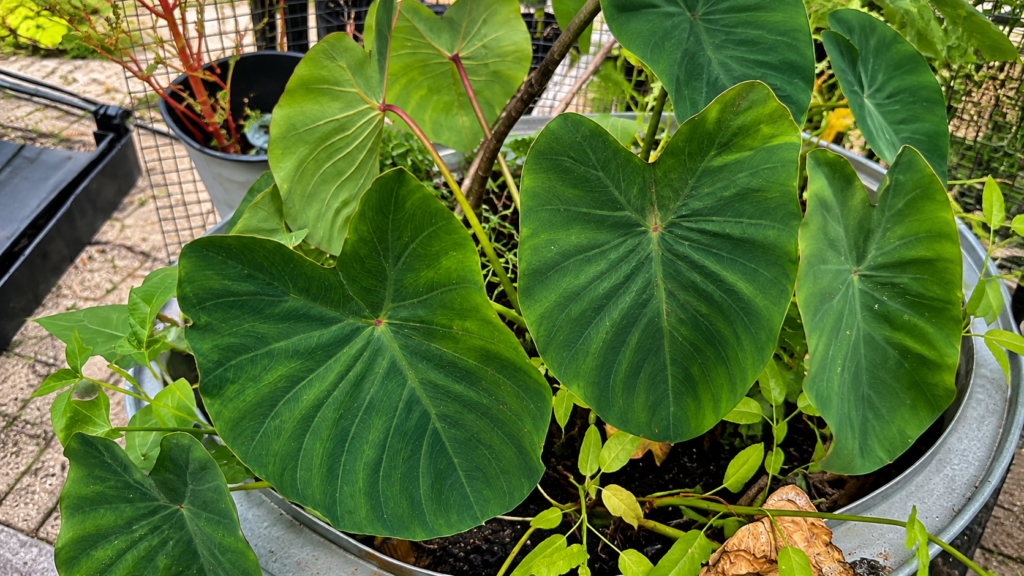
Taro, or gabi, is one of those plants that can be both food and garden plant. I have grown it before, but my previous plant didn’t make it through the winter. So I planted another one. This time, I decided to try something different—an old dryer drum.
And so far, the plant seems pretty happy with the arrangement.
Taro is especially interesting if you don’t have a traditional vegetable garden. It likes moisture, produces new shoots around the original plant, and can eventually form a sizeable clump. That’s one reason I like growing it in a container: I can keep an eye on it instead of letting it take over an area.
But there is more to gabi than its big green leaves.
What Is Taro or Gabi?
Taro generally refers to Colocasia esculenta, a tropical plant grown for its underground corm and, depending on the type and culinary tradition, its leaves and stems.
In the Philippines, it is commonly called gabi.
The plant grows from a large underground corm and can produce additional shoots and offshoot corms. That’s the part I find interesting as a gardener.
You don’t necessarily have to plant every new plant yourself.
One established plant can produce new shoots around the original, gradually creating a larger clump. UF/IFAS describes taro as producing thick shoots, stolons and offshoot corms.
Why I Like Growing Taro in a Container
I’ve always kept my taro in a container.
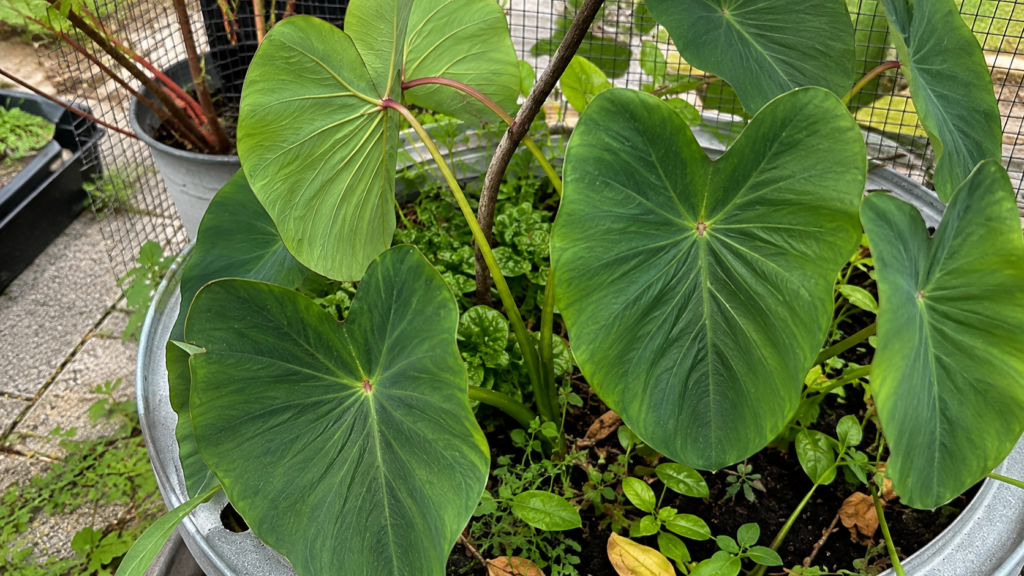
My previous plant eventually died during winter and didn’t come back, so I started over with a new one. This time, instead of using an ordinary garden pot, I’m using an old dryer drum.
It gives the plant plenty of room while putting a piece of otherwise-useless equipment back to work.
And that’s one of the things I enjoy about container gardening: you don’t always need a fancy planter.
An old container, barrel or other suitable vessel can sometimes become useful garden space. UF/IFAS notes that vegetables can be grown in containers on patios, balconies, along fences and in other places where a traditional garden bed isn’t practical.
Does Taro Like Wet Soil?
This is one thing I noticed long before I started researching the plant.
Taro likes moisture.
You often see it growing in wet places, and Colocasia esculenta has become established around streams, canals, marshy areas and shorelines in Florida. UF/IFAS describes wild taro as a perennial with thick shoots from a large corm and additional offshoot corms.
But there’s an important distinction for container gardeners.
Moist soil doesn’t automatically mean you should keep a container permanently flooded.
Container conditions are different from a natural wetland. Drainage, the growing medium, temperature and the size of the container all matter.
So I pay attention to the moisture rather than simply dumping water into the drum and forgetting about it.
Taro Can Multiply Without You Planting Every Plant
This is probably one of the coolest things about growing gabi.
You start with one plant.
Then new shoots appear around it.
Those shoots can develop into additional plants, and before long, you can have a much larger clump.
That’s what makes taro different from a crop where you plant every individual plant from scratch.
UF/IFAS confirms that Colocasia esculenta produces offshoot corms and can form dense populations through vegetative growth.
For a home gardener, though, this is also something to keep under control.
If you’re growing it in a container, keep the plant contained.
Don’t throw unwanted pieces into a ditch, pond, canal or natural area.
What Does Taro Need to Grow?
You don’t need a complicated setup to get started.
Warmth
Taro is a tropical plant. Cold weather can damage or kill the foliage. In warmer conditions, the plant can resume growth from its underground parts.
That lines up with my own experience: my previous container-grown plant didn’t survive the winter, which is why I’m starting again with a new plant.
Moisture
Keep the growing medium from becoming excessively dry. Taro is well adapted to moisture-retentive conditions.
Room to Grow
Don’t underestimate the size this plant can reach.
The leaves can become quite large, and the plant can gradually produce additional shoots. Give it enough room for the leaves and the expanding clump.
A Suitable Container
My dryer drum is certainly not the conventional choice, but that’s part of the experiment.
Whatever container you use, make sure it is physically sound and suitable for gardening. Drainage is important for container gardening generally, and UF/IFAS recommends watering containers thoroughly while allowing excess water to drain away.
Can You Eat Taro?
Yes, properly prepared taro is used as food, but this is one plant where you don’t want to experiment with eating it raw.
The underground corm is used as a starchy food, while taro leaves are used in various cooked dishes.
One of my favorite ways to eat the leaves is laing, where the leaves are cooked with coconut milk.
That’s probably one of the biggest reasons I keep coming back to this plant.
It’s not just something interesting to grow.
I actually want to eat it.
Why Does Raw Taro Make Your Mouth Itch?
Here’s where things get serious.
Taro contains calcium oxalate crystals, which can cause irritation when the plant is eaten or handled improperly. UF/IFAS specifically notes calcium oxalate/oxalic acid concerns with Colocasia esculenta, and Florida guidance warns that the plant can cause irritation.
That’s why proper preparation and cooking matter.
The old saying that you can just pick a taro leaf and eat it like spinach is not something I’d recommend.
Different taro varieties and culinary traditions use different preparation methods, but the important beginner rule is simple:
Don’t eat taro raw, and don’t assume every elephant-ear-looking plant is an edible taro.
If you’re unsure what plant you have, get it positively identified before eating it.
Taro, Elephant Ear or Something Else?
This is where things get confusing.
Several plants are commonly called elephant ear, including Colocasia, Alocasia and Xanthosoma. They are not interchangeable simply because they have big leaves.
UF/IFAS says taro can be distinguished from some similar plants by where the leaf stalk attaches to the leaf. In taro, the stalk attaches to the back of the leaf blade rather than directly at the edge/base.
So if you are growing something because you intend to eat it, identify it first.
A big leaf doesn’t automatically mean gabi.
What Nutrients Does Taro Provide?
Taro is primarily a starchy carbohydrate food, but it also provides fiber and several vitamins and minerals.
Depending on the part of the plant and preparation, taro can contribute nutrients such as:
- Dietary fiber
- Potassium
- Calcium
- Magnesium
- Phosphorus
- Iron
- Vitamin C
- Several B vitamins
The exact nutritional profile varies with the variety, plant part and cooking method, so I wouldn’t treat taro as a substitute for a broad range of vegetables.
I think of it more simply:
It’s a useful food crop that also happens to be an interesting plant to grow.
What About Taro in Florida?
Here’s something Florida gardeners should know.
UF/IFAS currently classifies wild taro (Colocasia esculenta) as invasive in Florida and recommends against planting it because established populations can spread aggressively and displace native shoreline vegetation. It is already widespread in parts of the state, particularly around wet areas.
That doesn’t change what I’m doing with my container experiment, but it does change what I would recommend to other Florida gardeners:
Keep taro contained and never intentionally release plant pieces into waterways, wetlands, ditches or natural areas.
If you already have a plant and aren’t certain what species it is, your local UF/IFAS Extension office can help with identification. UF/IFAS specifically recommends getting uncertain plants identified rather than assuming they’re wild taro or another species.
Growing Taro in a Small Space
My old dryer drum is a good example of something I’ve learned from gardening over the years:
You don’t always need a traditional garden bed to grow something interesting.
A container can turn a patio, corner of a yard or another unused space into a growing area.
And if you’re interested in this approach, I’ve also written about small-space gardening and container gardening, where I look at other ways to make limited garden space useful.
Easy Container Gardening Ideas for Small Yards
The point isn’t to turn every little corner into a jungle.
It’s simply about using the space you already have.
What I’m Watching With My New Taro
This is where the experiment gets interesting for me.
I’m watching:
- How quickly the plant grows
- How many new shoots it produces
- How large the leaves become
- How much water it needs
- What happens when temperatures drop
- Whether the dryer drum gives the corm enough room to develop
I’ll be interested to see how this new plant performs compared with the one I grew previously.
And that’s really the fun part of gardening.
You don’t always know exactly what you’re going to get until you grow it.
Gardening Products Worth Watching During Labor Day Sales
Since this is a container-growing project, there are a few gardening products that naturally connect with what I’m doing.
Rather than stuffing this article with ten unrelated products, I’d keep the list short and useful:
- Potting Mix & Garden Soil — essential for container gardening and other growing projects.
- Planters & Containers — useful when plants need more room for healthy root growth.
- Garden Tools — practical tools for planting, pruning, harvesting, and routine garden maintenance.
- Grow Bags — a useful option for gardeners working with limited space, patios, or small growing areas.
- Watering Equipment — hoses, watering cans, and other supplies that help maintain consistent moisture.
Final Thoughts
I didn’t start this Taro project because I needed another plant.
I started it because I like gabi, I like growing things, and I wanted to see what would happen if I gave a new plant an old dryer drum instead of a traditional planter.
The fact that taro can produce new shoots makes it even more interesting. One plant can gradually become a whole clump.
For me, that’s the fun of gardening.
Sometimes the best gardening experiment isn’t the one with the fanciest equipment.
Sometimes it’s the old dryer drum sitting in the yard.
A Note for Readers
If you’re in Florida and think you have taro, elephant ear or another similar plant, identify it before eating it or allowing it to spread. Several plants share similar common names, and Colocasia esculenta is currently classified as invasive in Florida.